
 More
More Buy Artworks
 Buy Gifts
 Specials
 Printing Service
 Online Exhibitions

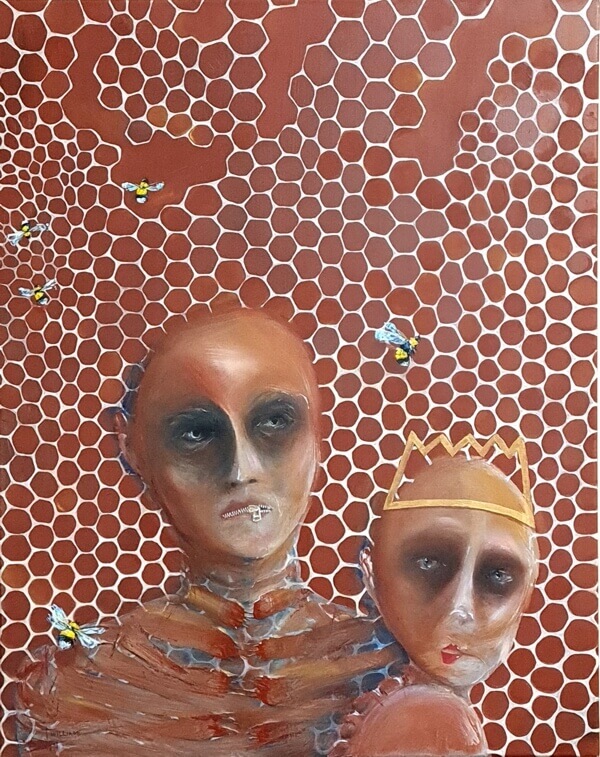
Artist: Tamantha Williams
Title: Schadenfreude
Medium: Oil on canvas – unframed
Size: 56cm x 70cm
Brief synopsis:
Ever had a bully steal a sweet from you only to have it confiscated by the teacher? Ever felt joy in the turn of events?
The Japanese have a saying: “The misfortunes of others taste like honey.” The French speak of joie maligne, a diabolical delight in other people’s suffering. The Danish talk of skadefryd, and the Dutch of leedvermaak. In Hebrew enjoying other people’s catastrophes is simcha la‑ed, in Mandarin xìng‑zāi‑lè‑huò, in Serbo-Croat it is zlùradōst and in Russian zloradstvo. More than 2,000 years ago, Romans spoke of malevolentia. Earlier still, the Greeks described epichairekakia (literally epi, over, chairo, rejoice, kakia, disgrace). “To see others suffer does one good,” wrote the philosopher Friedrich Nietzsche. “To make others suffer even more so. This is a hard saying, but a mighty, human, all-too-human principle.”
The smiles of Schadenfreude and joy are indistinguishable except in one crucial respect: we smile more with the failures of our enemies than at our own success.
Far harder to acknowledge, even to ourselves, are those spasms of relief which accompany the bad news of our annoyingly successful friends and relatives. They come involuntarily, these confusing bursts of pleasure, swirled through with shame. And they worry us—not just because we may fear that our lack of compassion says something terrible about us, but because they point so clearly to our envy and inferiority, and the way that we eagerly clutch at the disappointments of others in order to feel better about our own.
As we take in the misfortune of others delightfully it only solidifies and magnifies our own misfortunes. The foundational discomfort comes about in our realisation that in celebrating the misfortune, we are pulling away from love, we end up being stuck with ‘conflicting emotions’ being pulled in opposite directions. Instead of acknowledging the giving of love and compassion within for the misfortune it becomes easier to see the misfortune in the other and keep the unease. Looking on this negativity and loving it to wholeness becomes tougher than embracing the the internal negativity thus leaving it in place.
The fear is not in the opening of the door, the fear sits in not knowing what we will find.


Reviews
There are no reviews yet.